Fun science Study notes Biceps Biology Diagrams Muscular Anatomy. The elbow flexors consist of the biceps, brachialis, and brachioradialis. The biceps tendon attaches to the radial tuberosity, while the brachialis attaches 11 mm distal to the tip of the coronoid. Secondary static stabilizers include the radiocapitellar joint, joint capsule, and flexor and extensor origins. The radial

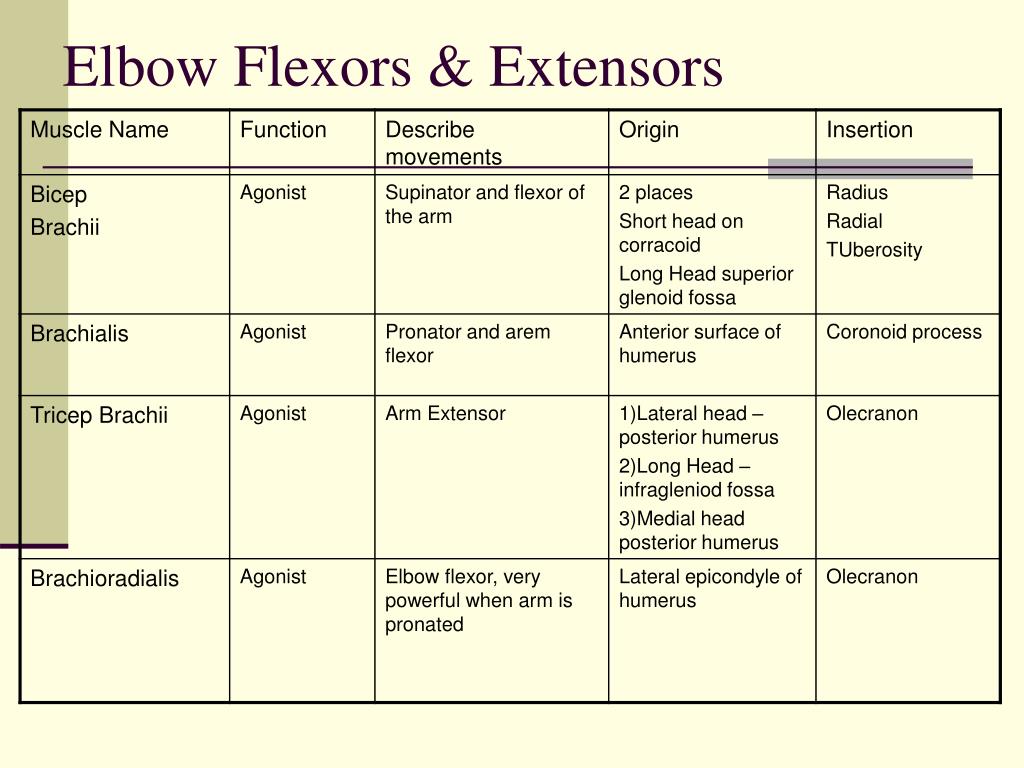
Flexion and Extension . Muscles of Elbow joint [edit | edit source] Flexors of Elbow [edit | edit source] Biceps Brachi---Powerful flexor when elbow is in 90 degree Flexion. Brachialis----Flexor of elbow in all position; Brachioradialis---Flexor of elbow in midprone position; Extensors of Elbow [edit | edit source] TRICEPS is the powerful The posterior tricep, medial flexor-pronator, lateral extensor-supinator, and anterior bicep are the four substantial muscle groups the ability to support the elbow. Elbow joint compression happens as any muscle group relaxes. Primary Elbow Flexors. Brachialis; Biceps brachii; Brachioradialis; Secondary Elbow Flexors. Pronator teres

Structure, Function, Location, Anatomy, Diagram Biology Diagrams
Nothing makes the anatomy of the forearm flexors fun and easy-to-learn like our video tutorials, quizzes, and articles. Don't miss checking them out in our study unit! extensor pollicis brevis, extensor pollicis longus) Elbow anatomy. Anular ligament of radius Ligamentum anulare radii 1/3. Synonyms: none. The elbow
In this article, we shall look at the anatomy of the elbow joint - its articulating surfaces, movements, stability, and the clinical relevance. Premium Feature 3D Model. Epicondylitis (Tennis elbow or Golfer's elbow) Most of the flexor and extensor muscles in the forearm have a common tendinous origin.

Elbow anatomy, biomechanics and clinical examination Biology Diagrams
The elbow joint is controlled by four main muscle groups: flexors, extensors, supinators and pronators. Numerous important structures cross the elbow joint: the brachial artery supplying the forearm, wrist and hand, and branches of the brachial plexus, principally the median, radial and ulnar nerves.

The muscles surrounding the elbow are primarily responsible for flexion, extension, and forearm rotation. They are divided into flexors, extensors, and rotators: Flexor Muscles. Located in the anterior compartment of the arm: Biceps Brachii: Responsible for elbow flexion and supination. Brachialis: Primary muscle for elbow flexion.
